
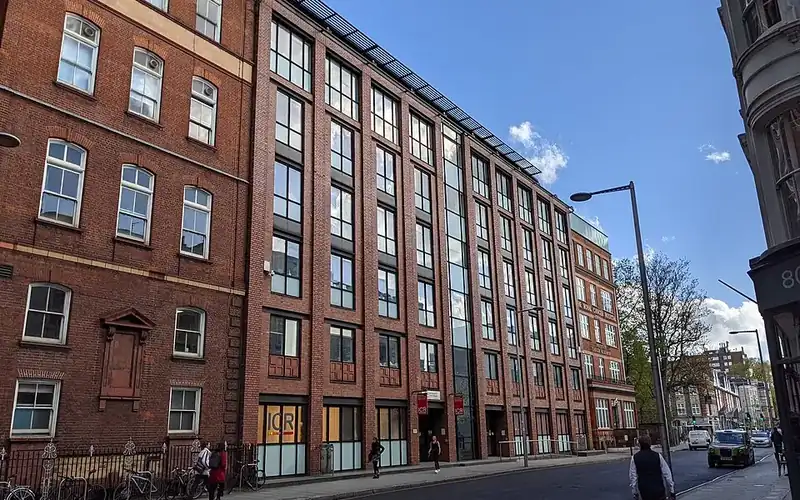
About the university
The Institute of Cancer Research (ICR) in London is one of the world's leading cancer research centres and a member institution of the University of London. It works with its hospital partner, The Royal Marsden, and came second in the REF 2021 league table of university research quality, impact and environment. It teaches only at postgraduate level, mainly through a competitive PhD programme.
Indian students can join as funded PhD students: the ICR sponsors Student visas for research degrees, and its studentships cover fees and pay a stipend (the ICR student stipend is £26,505 a year). Some projects are open only to students eligible for home fees, so check each advert. The ICR does not publish a current international tuition fee for any programme, so no courses with fees are listed here. Its MSc in Oncology is a part-time, day-release course for practising doctors.
- Type
- Specialist cancer research institute and registered charity; a member institution of the University of London
- Study levels
- Research degrees (PhD) and a part-time MSc in Oncology for doctors; no undergraduate courses
- Research
- More than 120 research groups across eight divisions
- Hospital partner
- The Royal Marsden NHS Foundation Trust
- Student visa
- Holds a Student visa sponsor licence and can issue a CAS for research degrees
Rankings
Popular courses with Indian students
Institute of Cancer Research doesn't publish course-by-course fees for international students online. See the courses on the official website (opens in a new tab), or ask our counsellor for the current list and fees.
Scholarships
- PhD
ICR PhD studentships
Value: Fees, running costs and a tax-free stipend (ICR student stipend £26,505 a year)
Eligibility: Applicants for advertised PhD projects. Some projects are open only to candidates eligible for home tuition fees; check each advert.
Official page (opens in a new tab)
Admission requirements
Undergraduate
- The ICR does not offer undergraduate degrees.
Postgraduate
- PhD places are advertised as individual funded projects; for October 2026 entry the deadline was 3 May 2026.
- The MSc in Oncology is a part-time, day-release course for medically qualified doctors specialising in oncology, so it does not suit a Student visa.
- Once your application is accepted, the ICR can issue a Confirmation of Acceptance for Studies (CAS) for your Student visa.
Documents
- Valid passport
- Degree certificates and transcripts
- CV and references, as asked for in the project application
- Proof of English (an approved test or a degree taught in English)
Check if you are eligibleShare your marks and test scores and our counsellor will tell you which courses you can apply for.
English language requirements
| Test or route | Typical requirement |
|---|---|
| Student visa minimum | The ICR says Student visa applicants must prove English at CEFR B1 or above, through an approved English test or a degree taught in English. |
| Project-specific requirements | Check each PhD advert and the application process page for the score the ICR asks for. |
Accommodation and living costs
The ICR has no student accommodation of its own. Full-time students can join the waiting list for University of London intercollegiate halls or apply to Goodenough College, and the ICR provides an accommodation booklet written with current students. Private landlords usually ask for a deposit of one or two months' rent.
| Item | In GBP | Approx. in rupees |
|---|
Campus and location
The ICR works alongside The Royal Marsden, one of the world's top cancer research and treatment centres, so PhD students train close to cancer patients and clinicians.
- More than 120 research groups in eight divisions and over 25 research centres and strategic initiatives.
- Member institution of the University of London, so students can use University of London intercollegiate services such as halls.
- Support for international students with visas, banking and moving to the UK.
Careers and graduate outcomes
ICR PhD graduates usually go on to research careers in universities, hospitals and industry. For post-study work rules see our UK country guide.
| What | Figure | Source |
|---|
Studying in the UK
Visa rules, work rights and living costs apply to every university in the UK. Our country guide covers them in detail:
Other universities in the UK

Photo: Hampshire County Council, OGL 3 PublicUniversity of Southampton (official website, opens in a new tab)
 Southampton, United Kingdom
Often chosen for Engineering, Computer Science & IT, Data Science & AI

Photo: DrPhoenix, CC BY-SA 3.0 PublicThe University of Manchester (official website, opens in a new tab)
Manchester, United KingdomOften chosen for Engineering, Business & Management, Life Sciences

Photo: Tim Green from Bradford, CC BY 2.0 PublicUniversity of Leeds (official website, opens in a new tab)
Leeds, United KingdomOften chosen for Business & Management, Engineering, Arts, Design & Media

Photo: Diliff, CC BY 3.0 PublicUniversity of Glasgow (official website, opens in a new tab)
Glasgow, United KingdomOften chosen for Life Sciences, Computer Science & IT, Law

Photo: Oscar Taylor, CC BY-SA 2.0 PublicCoventry University (official website, opens in a new tab)
Coventry, United KingdomOften chosen for Business & Management, Engineering, Arts, Design & Media

Photo: Simonham, CC BY-SA 3.0 PublicUniversity of Birmingham (official website, opens in a new tab)
Birmingham, United KingdomOften chosen for Business & Management, Engineering, Law
FAQs
Can Indian students study at the ICR?
Yes, at PhD level. The ICR holds a Student visa sponsor licence and recruits through funded PhD projects. Some projects are open only to home-fee students, so read each advert.
How much are the fees?
The ICR does not publish a current international tuition fee. Its studentships cover fees and running costs and pay a tax-free stipend of £26,505 a year.
Does the ICR offer a master's I can take on a Student visa?
Its MSc in Oncology is part time and day release, for practising doctors, so it is not designed for Student visa holders.
Sources
- The Institute of Cancer Research: homepage (opens in a new tab)
- The ICR: About us (opens in a new tab)
- The ICR: fully funded PhD projects (opens in a new tab)
- The ICR: support moving to the UK (opens in a new tab)
- The ICR: MSc in Oncology course essentials (opens in a new tab)
- The ICR: tuition fees (archived 2016/17 tables) (opens in a new tab)
Official website: www.icr.ac.uk (opens in a new tab)
Check the latest details